

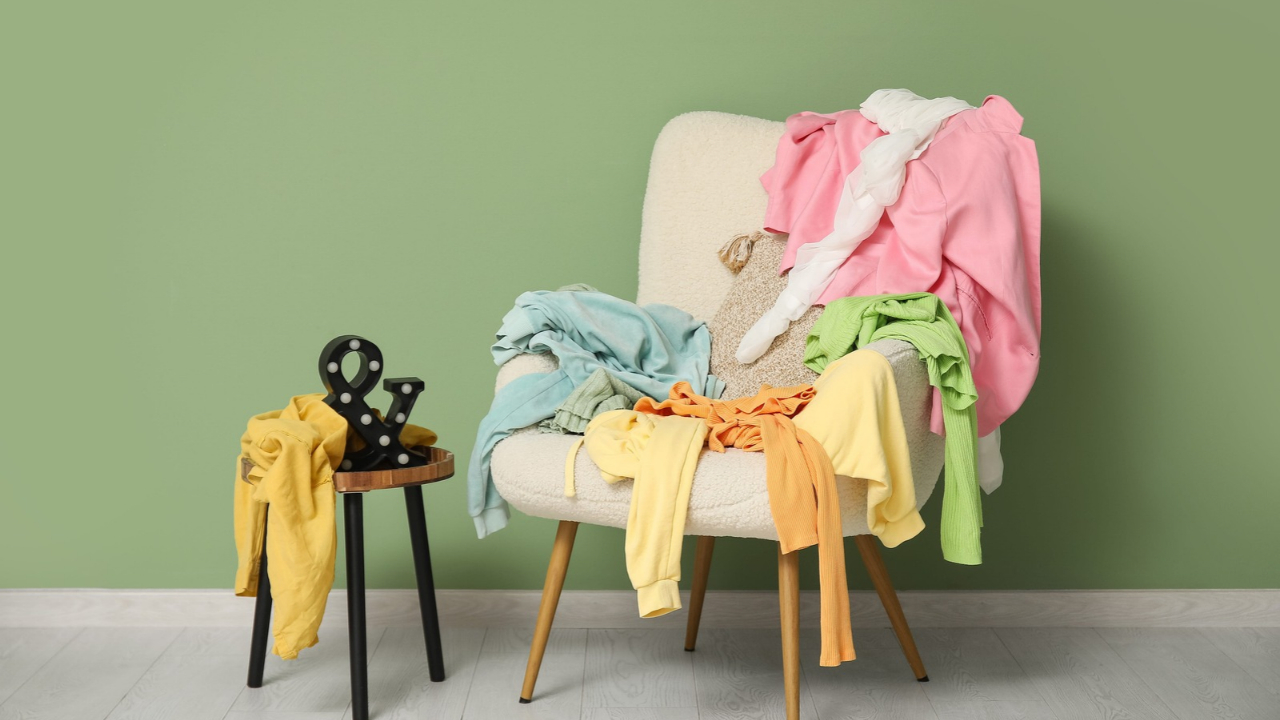
Two summers ago, I spent a weekend reupholstering a secondhand armchair in mustard velvet for our bedroom. Within ten days, it was holding my husband’s jeans, his work sweater, and one of my cardigans, which I would like to say was an accident.
Every bedroom seems to grow one of these chairs, and I no longer think it is a character flaw. Closets are built for clean clothes and hampers for dirty ones.
Nothing in a standard bedroom is designed for the jeans you wore for four hours and plan to wear again on Thursday.
The chair is filling that gap.
Closets Have a Spot for Clean and Dirty, but Not for Worn Once
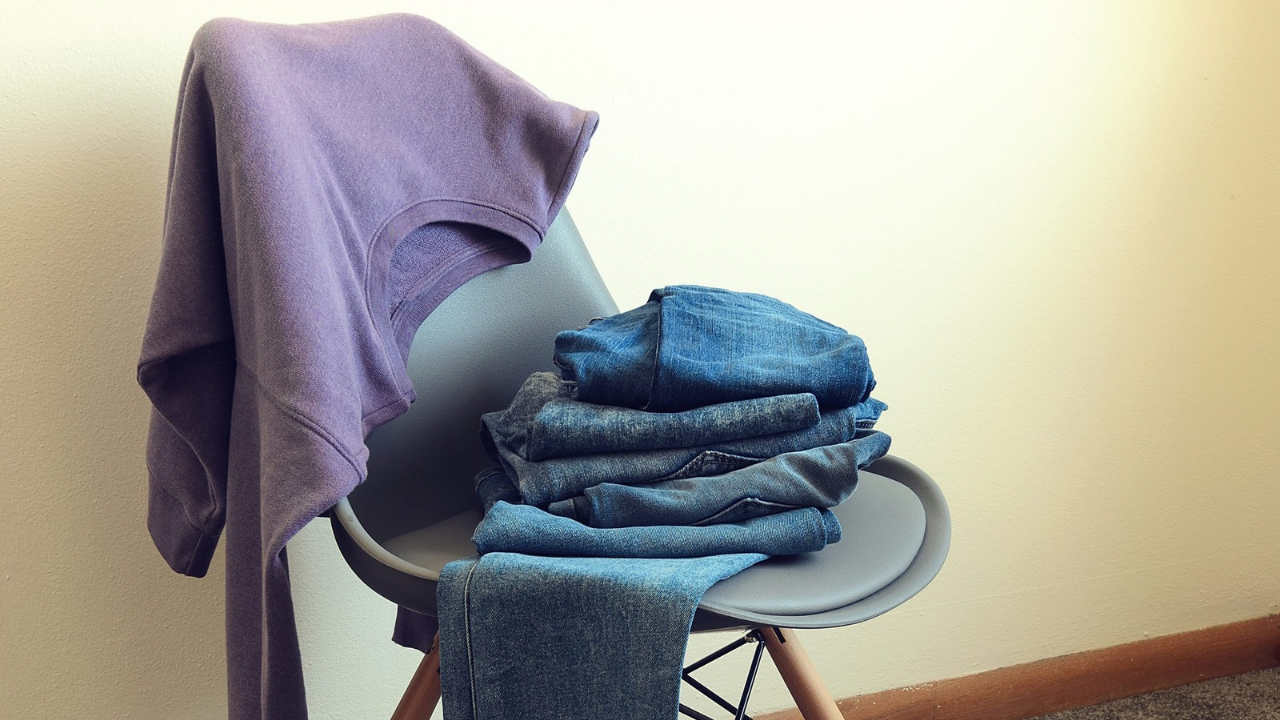
Many clothes are not meant to be washed after a single wear. A Utah State University Extension guide to how often to wash clothes, based on American Cleaning Institute recommendations, splits garments like this.
| Wash after | Examples from the USU guide | Where it waits in between |
| Every wear | T-shirts, socks, leggings, exercise clothes | Straight to the hamper |
| Three to four wears | Jeans, slacks, sweaters, skirts, dresses, pajamas, bras | Nowhere, unless you plan for it |
| Every three months | Jackets, vests, outerwear | Hall closet or hooks |
The middle row is the whole story. Some of the clothes we wear most often are supposed to be worn again before washing, yet most bedrooms give them no address. A chair happens to be nearby, open on top and quick to reach.
Worn Clothes Should Not Go Back Next to Clean Ones
View this post on Instagram
The obvious answer would be to hang worn clothes back in the closet. My germ-conscious side has never liked that, and entomologists give me a better reason than squeamishness.
According to the University of California integrated pest management notes on clothes moths, fabrics with food, sweat, or urine stains are more likely to be damaged, because the larvae feed less on clean fabric than on heavily soiled fabric. Wool and fur are among their usual targets.
My mother-in-law learned that the expensive way. She hung a camel-colored wool cardigan back in her closet after a Thanksgiving dinner, gravy spot included, and found a lacy row of moth holes along the cuff the next fall.
A worn sweater does not belong with clean ones in a dark closet for months. It needs air, a short wait, and a clear next step, which is exactly what the chair accidentally provides.
Every Bedroom in Our House Has Its Own Version
Before fixing anything, I spent one week simply noticing where the in-between clothes landed. Four people had four different strategies, and not one of them involved a closet.
- My husband uses the velvet armchair for jeans, belts, and the sweater he wore to the office.
- Our daughter, who is fifteen, has a floor version next to her bed, sorted by an internal logic nobody else understands.
- Pajamas belonging to our seven-year-old son get stuffed under his pillow, which honestly counts as a system.
- I drape my cardigan over the bedpost and pretend it is decorative.
Seeing it written down changed my view. Nobody in our house is careless. Each of us had invented a holding spot because the house did not offer one.
I Moved the Chair Out, and the Clothes Simply Moved Too
Rearranging is my reflex when something bothers me, the same impulse behind the stress cleaning I described in why cleaning feels good when life gets messy, so I tried the obvious fix first.
Down went the velvet chair to the living room, where it looks lovely next to the bookshelf, and I waited for my husband to start using his closet.
He did not. Within three days the jeans were folded over the footboard, and by the end of the week a sweater had reached the top of my dresser.
Popular advice such as the 48-hour rule in a Homes and Gardens guide to the clothes chair says anything left out for two days must be washed or put away. I understand the appeal, but it clashes with laundry guidance that allows jeans three or four wears. Forcing a wash early just adds laundry and wears the fabric out faster.
What the Viral Psychology Stories Leave Out
Every few months a headline announces that psychology has explained the clothes chair. A 2026 article in Hello magazine quotes a clinical psychologist who links the pile to decision fatigue and postponed choices. The idea is reasonable, but I read it carefully and found no study, survey, or data behind it.
Psychologists do recognize the Zeigarnik effect it mentions, a long-standing finding that unfinished tasks tend to stay on our minds. Nobody has tested whether it explains a pile of jeans.
Did you know? Inventor Simone Giertz built a chair with a backrest that swivels like a lazy Susan, so clothes hang on one side while you sit on the other. She told Fast Company in January 2025 that a chair should be designed for the many days it holds clothes, not the few days it does not. At the time, she planned to manufacture it.
I don’t think this solves the problem of clothes chair but it’s nice to feel seen.
— Clayton Guse (@ClaytonGuse) March 15, 2026
Gym Clothes Are the One Exception I Will Not Bend On
Not every garment deserves a waiting spot. My husband once left his running shorts on the chair overnight, and the whole corner of the bedroom announced it by morning.
Researchers at Ghent University have a likely explanation. In a study of 26 people after a spinning class, polyester shirts hosted more Micrococcus bacteria, which are linked to unpleasant odor, than cotton ones did, as NPR reported on the 2014 findings.
Our house rules are now short and firm.
- Anything worn to exercise goes straight to the hamper, even if it looks clean.
- Damp clothes never land on a pile, because trapped moisture turns musty fast.
- Worn clothes stay off the bed, since jeans that have sat on a soccer bleacher do not belong on the duvet.
The Middle Zone That Finally Worked for Us
The fix was not a better chair. It was giving each person an official waiting spot that is easier to use than the chair, which is the same rule I learned from watching Marie Kondo relax her own system once she had children.
- I screwed three hooks inside our closet door for my husband, using screws from my jar of spare IKEA hardware.
- Our daughter vetoed my cute woven basket and chose plain black hooks on her wall, which she has used for two months.
- One low hook beside his bed, labeled with his name, went to our son for pajamas only.
- I gave myself a shallow basket on the closet shelf that holds no more than four items.
The capacity limit matters most. When my basket is full, something gets worn, washed, or folded away. A hook works the same way, since it holds only one or two pieces.
Keep Any Clothes Pile Three Feet From a Heater
Fall changes the rules in our house. We live with old radiators, and our daughter runs a small portable heater in her room on the coldest nights.
The U.S. Fire Administration says in its portable heater safety flyer to keep heaters at least three feet from anything that can burn. A chair stacked with sweaters counts, and so does a floor pile next to the bed.
Earlier this month I measured the distance in her room with a tape measure while she rolled her eyes. Her hooks sit about five feet from the heater now, and the heater gets switched off when she leaves the room.
The flyer covers portable heaters rather than radiators, but I still keep damp clothes off ours, because they turn musty before they dry.
The Velvet Chair Holds Only a Blanket Now
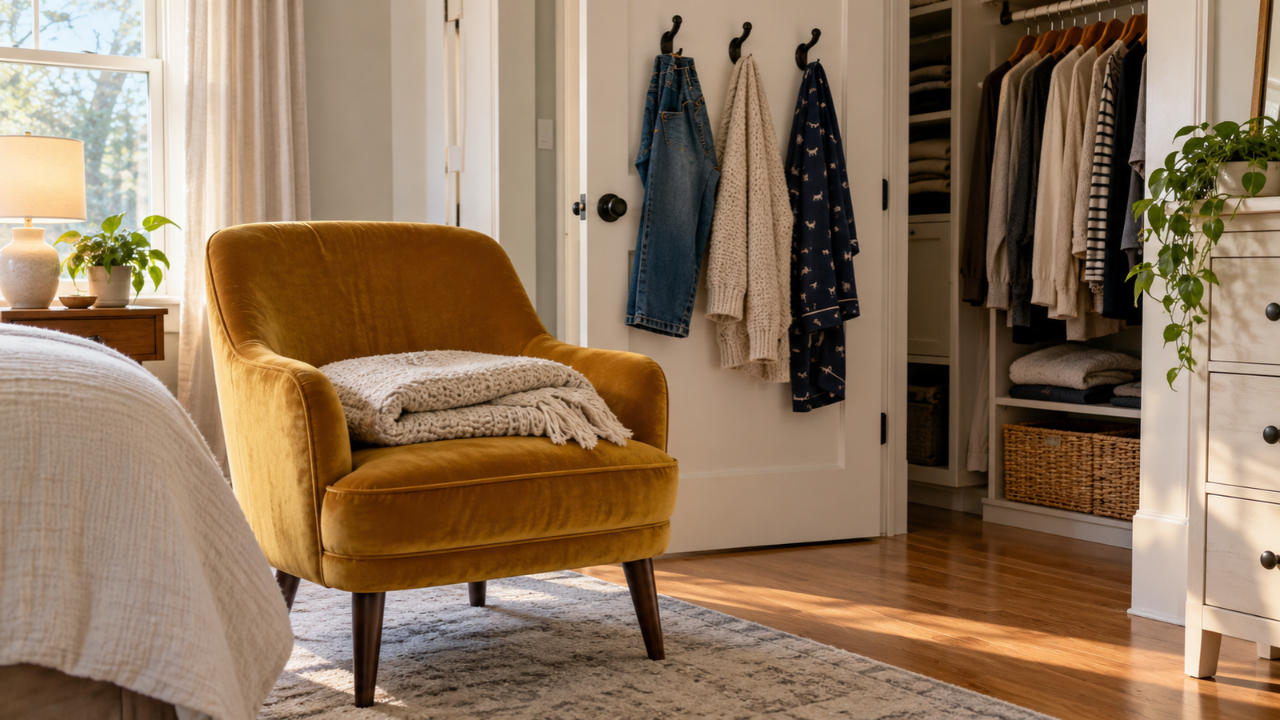
The mustard chair came back upstairs once the hooks went in. Some days it still collects a sweater, and I have stopped treating that as a failure.
The real change is that the chair no longer does a job the closet ignored. My husband’s jeans hang behind the door, our son’s pajamas wait on his hook, and our daughter guards her black hooks like a museum exhibit.
If your chair is buried tonight, count what is on it. Most of the pile is probably clothes waiting for a second wear, and they need a hook, not a lecture.